
The aerospace industry’s uncompromising focus on safety, reliability, and performance has set unprecedented quality benchmarks for manufacturing equipment—particularly for Tube end forming machines used in producing critical aerospace components. IO forming machines, designed to shape both inner and outer surfaces of tubes with exceptional precision, have emerged as indispensable tools in aerospace fabrication, enabling compliance with stringent industry standards that govern everything from material integrity to dimensional accuracy. As aerospace applications demand components that perform under extreme conditions—from high-altitude pressure fluctuations to extreme temperature ranges—IO forming machines are evolving to deliver the precision, consistency, and traceability required for mission-critical parts.
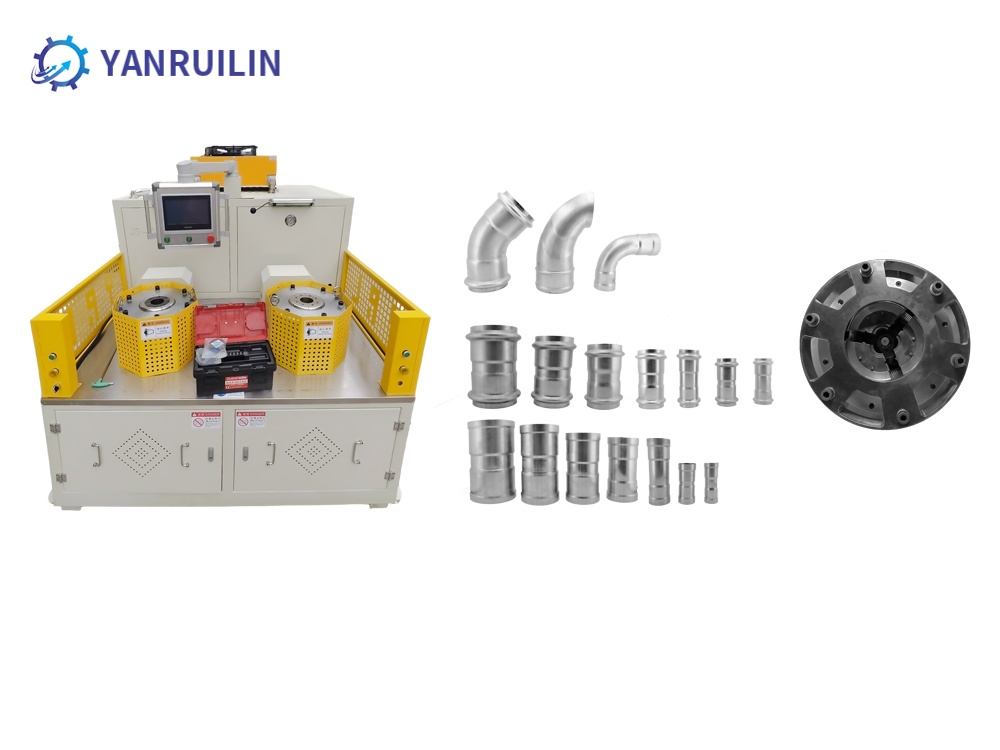
Aerospace quality standards, defined by global regulatory bodies and industry-specific requirements, mandate rigorous control over every aspect of tube forming. These standards dictate dimensional tolerances as tight as ±0.01 mm for critical tube features, resistance to fatigue and corrosion, and full traceability of manufacturing processes. IO forming machines address these demands through specialized design features that prioritize precision at every stage of the forming process. Unlike conventional single-sided forming equipment, IO machines integrate synchronized internal and external tooling systems, ensuring uniform material deformation and eliminating inconsistencies such as wall thinning, ovality, or uneven material flow—common pitfalls that can compromise aerospace component performance.
The core advantage of IO forming technology lies in its ability to maintain structural integrity while achieving complex geometries. Aerospace parts such as hydraulic lines, fuel system tubes, and engine cooling ducts often require intricate forms—including flared ends, threaded connections, and stepped profiles—that must withstand extreme mechanical stress. IO forming machines leverage advanced servo-hydraulic control systems to apply balanced pressure from both inside and outside the tube, preventing material distortion and ensuring that the final component retains its structural strength. This balanced approach is critical for processing high-performance aerospace materials, including titanium alloys, Inconel, and advanced composites, which are prone to cracking or deformation under uneven pressure.
Dimensional accuracy is further enhanced by closed-loop feedback systems integrated into modern IO forming machines. High-resolution linear encoders and pressure sensors continuously monitor tool positioning and force application, adjusting parameters in real time to correct for any deviations. This level of control ensures that every tube produced meets the exact specifications outlined in aerospace design documents, reducing the risk of non-conformities that can lead to costly rework or component rejection. For parts requiring multi-step forming operations—such as sequential flaring and threading—IO machines coordinate internal and external tool movements with micron-level synchronization, maintaining consistency across complex workflows.
Traceability, a cornerstone of aerospace quality compliance, is supported by built-in data logging and process monitoring capabilities. IO forming machines capture and store critical production data for every component, including pressure profiles, cycle times, tool wear metrics, and material batch information. This data can be seamlessly integrated into aerospace manufacturers’ quality management systems, providing a complete audit trail from raw material to finished part. In the event of an inspection or quality review, this traceability ensures that every step of the forming process is verifiable, demonstrating compliance with standards such as AS9100, ISO 9001, and specific aerospace OEM requirements.
Material compatibility is another key consideration for aerospace IO forming machines. Aerospace tubes are often manufactured from high-strength, corrosion-resistant materials that require specialized forming techniques to avoid compromising their inherent properties. IO machines address this through adjustable temperature control systems—some featuring in-process heating or cooling—to optimize material ductility during forming. Additionally, tooling materials are selected for compatibility with aerospace alloys, reducing friction and wear while preventing material transfer that could contaminate the tube surface. These design choices ensure that the formed component retains its mechanical properties, including tensile strength and fatigue resistance, critical for withstanding the harsh operating conditions of aerospace applications.
Reliability and repeatability are non-negotiable in aerospace manufacturing, where even minor variations can have catastrophic consequences. IO forming machines are engineered for long-term stability, with robust mechanical structures that minimize vibration and thermal drift during extended production runs. Precision-machined tooling holders and standardized mold interfaces ensure consistent setup across multiple production batches, while automated calibration routines maintain accuracy over time. These features reduce process variability, ensuring that every component produced is identical to the last—meeting the strict repeatability requirements of aerospace quality standards.
As the aerospace industry continues to push the boundaries of performance with lighter, more efficient designs, IO forming machines are evolving in tandem. Innovations such as adaptive forming algorithms, which adjust parameters based on real-time material analysis, and integrated non-destructive testing (NDT) capabilities—for in-process inspection of welds or material defects—are further enhancing quality control. These advancements not only ensure compliance with existing standards but also position manufacturers to meet the evolving demands of next-generation aerospace systems, including electric aircraft and hypersonic vehicles.
IO forming machines have solidified their role as critical enablers of aerospace quality, delivering the precision, traceability, and reliability required to meet the industry’s strictest standards. By addressing the unique challenges of forming high-performance materials into complex geometries, these machines ensure that aerospace components perform safely and reliably in extreme conditions. As regulatory requirements continue to tighten and manufacturing processes become more sophisticated, IO forming technology will remain at the forefront of aerospace fabrication, driving quality and innovation in mission-critical component production.
This website uses cookies to ensure you get the best experience on our website.

 Español
 Pусский
 Deutsch
 日本語
日本語 한국어
한국어 Italiano
 Türk dili
 हिन्दी
 Indonesia


Comment
(0)